






25 September 2026
 ‘The perfect setting for a dark, nerve-shredding thriller’
Rory Clements, Sunday Times bestselling author of A Cold Wind From Moscow
‘An absolute page-turner: gritty, atmospheric and gripping’
James Swallow, Sunday Times bestselling author of Nomad
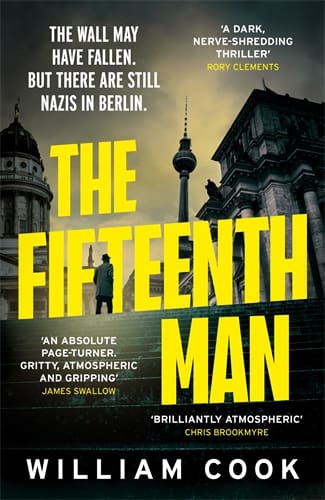
THE WALL MAY HAVE FALLEN.
BUT THERE ARE STILL NAZIS IN BERLIN.
Wannsee, 1942
Fifteen of the most powerful men in the Third Reich meet in secret. Their goal: the implementation of the Final Solution.
West Berlin, 1990
Anglo-German journalist Michael Braun makes a living tracking down old Nazis. But since the fall of the Berlin Wall, Fleet Street’s interest has waned, and he needs more than another concentration camp guard or petty bureaucrat to sell a story. Then Braun is offered an improbable assignment: during the storming of the East German Stasi headquarters, files were found that show a Nazi may have been hiding in Berlin for decades. And not just another low-ranking soldier but Heinrich Müller, head of the Gestapo. The only Nazi at the Wannsee Conference whose fate is unknown since he disappeared from Hitler’s bunker in 1945.
Desperate for money, Braun takes the job. But the man he’s hunting – Müller or not – knows how to stay hidden. And how to protect his secrets…
I’d been back in West Berlin for six months when the Wall came down. I didn’t join in the celebrations. I’d come here to take it easy, to write a few tame travel stories while I wondered what to do with the rest of my life – or the next few years, at least. Back then, Berlin was as dead as Ephesus. It was a place whose time had passed. But then the Wall fell, overnight, in an avalanche of naff graffiti, and suddenly the wide, empty streets of this glum metropolis were awash with TV reporters and camera crews, interviewing anyone they could find or, if all else failed, each other.
Before the Wall came down, hardly any foreign journalists lived in West Berlin, and that was just the way I liked it. The political correspondents were based in Bonn, the financial reporters lived in Frankfurt, and most freelancers preferred Munich. They might fly in to cover a breaking story, but once they’d filed, they usually flew straight out again. And so, for those first six months, I had the whole city more or less to myself.
Not that I filed much copy. At first, I didn’t need to. I’d split up with my wife; she’d kept the house and I’d been left with a modest pay-off. Fuck-off money, I think they call it. Not much to show for fifteen years. At first, I thought it would be enough to buy a studio flat in a less salubrious part of London, but by the time the lawyers had taken their slice there wasn’t enough left over to buy anything in the Big Smoke, not even in the cheapest and nastiest part of town. Renting anywhere in London would soon have wiped out my paltry windfall, and so I returned to the city where I’d spent my misspent youth, hoping to rekindle the thrill I’d felt when I’d first come here, in the late, unlamented 1970s.
As soon as I arrived, I realised I was chasing shadows. The Berlin I’d fallen for first time around was the city of my early twenties. Now I was nearly forty – too old, too tired, too late – and the back-street dives that had seemed so thrilling then now felt cold and lonely. Divorce had left me dead inside. My dancing days were over. Still, the rents were low, the living was easy, and most people minded their own business. It was a place where you could do as little work as possible and still just about get by.
Of course, the smart thing to do would have been to buy a cheap conversion flat in some dismal dormitory town like Staines or Stevenage and rent it out, to give me a foothold back in Britain for the day when I was through with Berlin – or, rather, when Berlin was through with me. But I wasn’t feeling smart. I was feeling like a middle-aged drifter, a man without a future, and in those days a lot of drifters ended up in Berlin.
For anyone who’s spent a few years on Fleet Street, being a foreign stringer is a fairly easy way to pay your passage. You can work a few hours a day, a few days a week, and somehow scrape a living. I knew I’d never make much money from this racket, but during those first six months I didn’t care. Journalism gave me a few hundred Deutschmarks a week; not quite enough to live on, but enough to slow the constant leakage from my bank account from a torrent to a steady trickle. I didn’t hold out much hope of breaking even, let alone making a decent wage, but I figured the smaller my monthly shortfall, the longer my meagre savings would last and the longer I could postpone that fateful day I’d been putting off my entire life: the day when I’d have to put on a suit and tie and find some sort of regular employment.
Back in Britain I’d been an ordinary news reporter, bread-and-butter stuff, but I soon discovered that Fleet Street didn’t give a damn about what went on in Berlin from day to day. To make any money I needed some sort of specialism, and my journalistic speciality, it turned out, was tracking down old Nazis. It wasn’t a speciality I’d chosen. Like most things in life, I simply drifted into it. I didn’t have any particular desire to bring geriatric war criminals to justice. For me, it was just a job.
These stories were easy to place and usually pretty easy to research. I rarely had to start from scratch. Often, it was someone everyone knew about already. Sometimes I’d get a tip-off from a German journalist, one of the reporters on the local news beat. They were glad to see those old bastards named and shamed, but they didn’t want to do the dirty work themselves. West Berlin was a small town, and those old bastards had friends and relatives. That didn’t bother me. I had no social network, no influential contacts to maintain. My sources were the usual ragbag of inconsequential bureaucrats – middle-aged men in dead-end jobs with no hope of promotion, happy to trade some office gossip for a decent dinner and a few bottles of Riesling. There was no shortage of loose tongues in West Berlin, no shortage of resentful wage mules willing to dish the dirt on their superiors. Did I know that eminent civil servant had been a Kommandoführer in a concentration camp? Did I know that captain of industry had been a Sturmbannführer in the SS? ‘No, I had no idea. How interesting.’ ‘Strictly off the record, of course?’ ‘Of course. Do have another glass of Sekt …’ It was easy pickings – far simpler than proper news reporting. I only had to land a story once a month to pay the rent, and I soon discovered that one old Nazi every month was more or less what Fleet Street required.