







25 September 2026
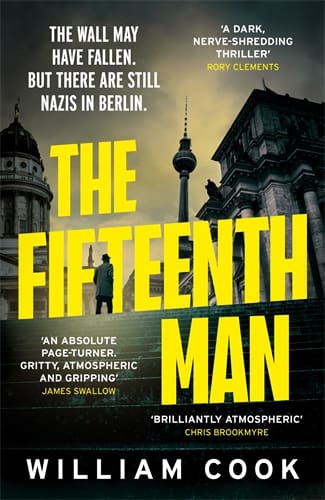
‘The perfect setting for a dark, nerve-shredding thriller’
Rory Clements, Sunday Times bestselling author of A Cold Wind From Moscow
‘An absolute page-turner: gritty, atmospheric and gripping’
James Swallow, Sunday Times bestselling author of Nomad
THE WALL MAY HAVE FALLEN.
BUT THERE ARE STILL NAZIS IN BERLIN.
Wannsee, 1942
Fifteen of the most powerful men in the Third Reich meet in secret. Their goal: the implementation of the Final Solution.
West Berlin, 1990
Anglo-German journalist Michael Braun makes a living tracking down old Nazis. But since the fall of the Berlin Wall, Fleet Street’s interest has waned, and he needs more than another concentration camp guard or petty bureaucrat to sell a story. Then Braun is offered an improbable assignment: during the storming of the East German Stasi headquarters, files were found that show a Nazi may have been hiding in Berlin for decades. And not just another low-ranking soldier but Heinrich Müller, head of the Gestapo. The only Nazi at the Wannsee Conference whose fate is unknown since he disappeared from Hitler’s bunker in 1945.
Desperate for money, Braun takes the job. But the man he’s hunting – Müller or not – knows how to stay hidden. And how to protect his secrets…
What drew you to writing The Fifteenth Man?
The original impetus for the book, I guess, was my father’s German heritage. He was born in Dresden in 1942, his German parents separated during the war, and after the war, in Hamburg, my German grandmother met a British officer called Gerry Cook (a journalist back in Civvy Street) and brought my father to England for Gerry to raise him as his own. When the Berlin Wall came down in 1989, I’d just started out as a journalist, so I started travelling to Eastern Germany, ostensibly as a travel writer, but also to try and find out what became of my German family – in particular my German grandfather, a feckless toff who grew up in a Schloss in Eastern Germany and died in mysterious circumstances in 1972. I wrote various articles about this subject and spent many years trying to turn this journalism into a book. To my surprise, it gradually mutated into fiction.
The Fifteenth Man is atmospherically set in Cold War Berlin. Why did you choose this setting, and how did you conduct your research to capture this particular place and moment in time?
Although The Fifteenth Man is set in Cold War Berlin, most of the action in the book takes place in 1990, at the very end of the Cold War, after the Berlin Wall came down. I suppose there were several reasons why I chose this time and place. As for the place, Berlin is the foreign city I know best –and it’s the city I’ve always found most fascinating, due to its unique history. As for the time, I first went to Berlin in 1991, 18 months after the Wall came down, and I was intrigued to find that, though the Wall was no more, Berlin still felt like two separate cities. I wanted to write about a time and place I knew, and it seemed to me that Berlin in 1990 was an extraordinary moment in European history: after the fall of the Wall but before German reunification (which didn’t happen until a year later). I’d read numerous novels set in Berlin while the Wall was up. I’d never read one set in Berlin just after the Wall came down.
As for the research, I’ve been travelling to Germany pretty regularly over the last 35 years, as a reporter for the Independent, Conde Nast Traveller and the Spectator, among others. Although this was all post-reunification, the traces of the old East Germany were still very visible – especially during the Nineties and the Noughties – and I met many Germans who’d lived under the East German regime and told me about their experiences. I never planned to turn this journalism into a novel, but it turned out to be a fertile form of research.
Are there any books or films that inspired your writing?
I certainly didn’t start writing this novel with any books or films in mind – indeed, I tried to put anything I’d seen or read out of my mind when I wrote it. However, looking back, I guess there are some books and films I like which may have influenced it in some way. Funnily enough, the book that seems closest to The Fifteenth Man (for me) is Selling Hitler, a non-fiction book by Robert Harris, written before he turned to fiction, although it reads like a novel. It’s about the (fake) Hitler Diaries, an Anglo-German journalistic scandal in the 1980s. There’s also a crazy German film about the same subject called Schtonk! It’s one of my favourite films, but the broad comic tone of that movie is a world away from The Fifteenth Man. A fabulous German film that feels a lot closer (to me) is The Lives of Others, about the Stasi. Anna Funder’s Stasiland is a fantastic (non-fiction) book about the same subject.
I read loads of thrillers in my early teens – Hammond Innes, Alistair MacLean, Dick Francis, Desmond Bagley – and after all those years it seems their influence still seeps through.
What’s your writing process and do you have any tips for aspiring authors?
Having spent over 30 years trying (and failing) to write fiction, and having finally finished my first novel at the age of 60, I fear I’m probably the last person who should be giving tips to any aspiring fiction writers! If you want to write a successful novel at half my age (which would be a much better way of doing things), maybe you should try to do the opposite of whatever I’ve done! I’ve spent most of my life writing non-fiction – mainly biographies and journalism – and for this, and for fiction too, the writing process and the writing tip is the same: sit down and do it, and keep on doing it. Writing doesn’t come from inspiration – inspiration comes from writing. Set yourself small targets. A page at a time, a paragraph at a time – even a decent sentence is enough. Get something down on paper – anything – then work with that. The first draft of anything is (nearly) always bad and rewriting (nearly) always makes it better. The big difference between fiction and non-fiction, it seems to me, is that if you keep doing those things with non-fiction, you should eventually write something worth publishing. With fiction, you may not – although you still have to do those things to even give yourself a chance. For a long time my fiction didn’t work at all, and then it did – sort of. I don’t know why. I hope it works again.