







13 May 2026
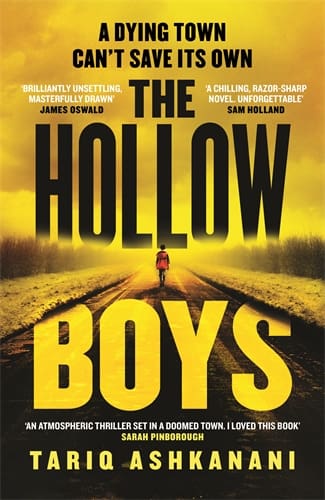
* THE NEW NOVEL FROM THE PRIZE-WINNING AUTHOR OF THE MIDNIGHT KING *
‘A brilliantly unsettling piece of purest American Gothic’ – JAMES OSWALD
‘The master of the small-town thriller at the top of his game’ – JANICE HALLETT
‘An atmospheric thriller. I loved this book’ – SARAH PINBOROUGH
Two children lost. The wrong one found.
The town of Aurora is waiting to die. A few miles away a deep seam of coal burns underground, the fire creeping closer ever year. Businesses close. Families leave. Hope dwindles.
And then one day, nine-year-old Danny Yates comes back from the dead. He walks into town half-starved and silent, ten months after he and his best friend Will Keefe were presumed drowned. But when Danny does finally speak, he swears that he’s not Danny anymore. He’s Will.
Danny’s mother is convinced that her boy has come back wrong, and that the town itself is now at risk from whatever dark force returned her son. Chief of Police John Deacon is more interested in how the sinister disappearance of two boys could have been written off as a tragic accident, and who was responsible. What happened to Danny to make him take on his friend’s name, his personality? And does Danny’s return mean there’s a chance that Will is still alive?
The setting for The Hollow Boys is a dying rust belt town called Aurora. How did you create this fictional setting, is it based on somewhere real?
I knew I wanted to set the book somewhere in the rust belt – it’s such a fascinating place to tell a story, I think. There’s so much history there, so much emotion. I truly believe that the location of a story can be a character in its own right; it can say so much about why people act the way they do, and the type of people that choose to stay and live there. There’s an inherent sadness to these small towns, one that filters its way through every part of them. The streets, the people, even the weather.
I read a couple of really influential books to flesh out this region – American Rust by Philipp Meyer and Detroit: An American Autopsy by Charlie LeDuff. These were both hugely helpful in giving me some insight into the decline of this area.
I came across Centralia during a Wiki-dive on the rust belt, and as soon as I saw it I knew I had to include it somehow. The idea of this coal seam fire burning for hundreds of years and steadily taking out other towns as it goes was just too irresistible to pass up. It seemed like the perfect fodder for Aurora – this depressive inevitability bearing down on it, this notion that no matter how much you tried to save something, it was never going to survive.
Both The Hollow Boys and your previous thriller The Midnight King are, at their core, about missing children. What is it about this subject that you are drawn to?
I love to write stories that scare people. I think crime and horror are two sides of the same coin at times, and ever since becoming a father, one of the biggest fears that I’ve unlocked is something happening to my kids. It might therefore seem weird to want to write about kids going missing, but I genuinely think it’s a little like therapy. You dive into this stuff and you offload the stresses and concerns you have, and you give them to your characters and you work it through with them.
People say you should ‘write what you know’, and I agree with that to an extent. I think writing about something you feel passionate about, that you can speak with authority about, is really the key to any project. You want to find that vein of humanity, that bit of truth inside that scares you a little, and put it down on the page. You feel much better afterwards, honest!
When Danny returns to Aurora, his mother Emily is convinced he’s come back altered, that this isn’t her son – a fear that’s perhaps encouraged by her obsession with practising folk magic. What sort of research into folk magic did you do to write Emily’s character?
I read a lot into the sort of rituals and practices that people who live in the Appalachian region might follow. I really wanted to draw a distinction between Emily and Anna’s character; both women have lost their sons, and they’ve both responded in different ways. Anna is the more practical person, perhaps grounded by still having two other children to raise. Emily would appear to be struggling more, at least on the surface. She’s been a believer in folk magic since childhood, and Danny’s disappearance only serves to heighten that belief. I wanted to show her sliding further and further into this obsession, and how her desperation pushes her down towards dangerous blood magic, as well as fuelling her perspective of what’s happening to the town.
I looked into all the different sorts of beliefs that Appalachian folk magic covered. I worked out what sort of stuff Emily might have started with – pinning horseshoes above a door for good luck, burying glass bottles filled with nails in the ground to ward off evil, for instance – and then steadily scaled that up as her views got more perverse. At the other end of the scale, the blood magic that she performs to bring Danny back, I did infuse a lot of artistic licence there. I wanted to keep that idea of her clutching at straws, believing in anything that might work, and it seemed logical to me that she would be prime for people to scam. Larkin – the man who tells her about the ritual – charges her for his knowledge. Is he teaching her real folk magic? Or is he just a slimeball preying on the fears of a grieving mother?
The driving force of The Hollow Boys is Chief of Police John Deacon’s investigation into what happened to Danny and the search for Will, aided by the FBI. In that sense, this is more of a procedural book than The Midnight King. Did you find following the strict rules of law enforcement useful, or did they make this a more difficult novel to write?
It was a little of both, honestly.
Having the hierarchy and structure of the police force in place was great at giving me a roadmap for the story. What sort of characters I would need, what sort of investigation they would do, that sort of thing. It also lends itself very easily to the classic crime story – dodgy witnesses, red herrings, cops putting themselves into dangerous situations, and so on.
It also solves the problem of giving the characters a reason to be investigating something in the first place. You don’t need to give them a personal tie to the crime. In fact, during rewrites on The Hollow Boys, I found I had to keep findings reasons for them not to be investigating whenever I wanted to dive into the characters’ personal lives a little!
In comparison, The Midnight King didn’t give me any of that, really. There were cops in it but they were minor characters. The downside of that was making sure that the leads (Isaac and Nathan) both had enough skin in the game to be wanting to solve the mystery. The flipside, however, is that you are totally free to let your characters do whatever they want. They’re not bound by laws, they can break into a house or beat up a suspect for info – something (most) cops wouldn’t do. They don’t have to follow a rigid hierarchy either; there’s no chief they need to report to, and it’s far easier to mix in their personal lives.
Your books are noted for their brilliantly unsettling atmosphere, often tackling the darker side of crime fiction. What writers inspire your work? Do you have any recommendations?
Oh, so many recommendations.
I’d say Thomas Harris has been a huge influence on me. Both Red Dragon and Silence of the Lambs in particular are stand outs in the genre. At their core, they’re just cat-and-mouse, cops-and-robbers stories, but they’re elevated massively by the prose and the characters. Harris spends so long fleshing out his baddies – the Red Dragon, for instance, has so much backstory that you completely understand why he does what he does. I don’t think enough serial killer books take the time to really delve into their villains.
Nic Pizzolatto is another favourite of mine. Obviously True Detective (season one, in particular) shares a lot of the stuff I love – small town, cops over their heads, horrific crimes to solve. When I was trying to find my ‘voice’ back in the day, I read Pizzolatto’s book Galveston, which he wrote before True Detective, and it’s such a brilliant, grizzled noir. The characters burst off the page, he writes them in such a gritty, almost painful way, like their throats are bleeding when they speak.
I’m also a huge fan of Jordan Harper. In particular Everybody Knows. It’s a modern-day noir set in LA, and he captures the bleakness and the claustrophobia of the genre so well. Much like S.A. Cosby (check out Razorblade Tears and Blacktop Wasteland) and Eli Cranor (Don’t Know Tough). These three authors I always link up in my head.
Finally, I have to give a shout out to the great James Ellroy. The Black Dahlia in particular is a masterpiece (although his entire L.A. Quartet, which also features L.A. Confidential, is amazing). His voice is simply unmatched in my opinion, his rat-a-tat prose, his dialogue, his characters – simply incredible. He’s not scared of writing characters that you will hate and then making them the main protagonist. His dense style of writing took me a little bit to click with, but once it did, it’s impossible to put down.